Wednesday, January 9, 2013

The Mystery of Akhenaten

Why does it seem like the reign of the heretic pharaoh, Akhenaten, just falls apart after his Year 12 when he is supposed to have ruled for 17?   The tombs of the nobles stop being decorated and, oddly, in one of the later ones, that of Meryre II, a new king suddenly appears.  His name is Smenkhkare and he and his queen, Meritaten, are depicted right around the corner from the triumphant depiction of the Great Durbar of Year 12, where Akhenaten celebrates in style before envoys from foreign lands.  Beyond the unfinished scene of Smenkhkare, there is nothing more in the tomb of Meryre, either.  What happened?  I have a scenario that, while seemingly strange, can provide a solution to the mystery.  Here it is:
 
Akhenaten became co-regent with Amenhotep III at the time of the latter's heb sed in his Year 34. In Akhenaten's own Year 3 [although he is still called Amenhotep], he celebrates a mirror heb sed with his father, who currently observes the jubilee of Year 37. Amenhotep III dies sometime in his Year 38, the fourth year of Akhenaten. In fact, he [as Amenhotep] is attested in his Year 4 at the Wadi Hammamat. There, two short graffiti of the high Priest of Amun, May,[perhaps Ptahmose] mention him being sent for bxn stone for a statue. So the cult of Amun is still alive in Year 4 of Amenhotep IV but, in Year 5, he changes his name to the familiar one and moves to a new capital Akhetaten, now Tell el Amarna.
 
11 years pass there and the 12th has begun. The children of Akhenaten and Nefertiti are growing up and some have become young ladies. Nefertiti is still by the  side of her husband. But Akhenaten, unconventional as ever, does something unusual in his Year 17. He proclaims a great celebration of Year 12, the total of years that he, as king of Egypt, has devoted himself completely to the Aten and has lived in this center of the worship of the god.  And so that is the date we see in the tomb of Meryre II-- Year 12, II prt, day 8—that is, 12th Year, 5 months and 8 days.   It is really not the current date, but the day of the durbar of the celebrating of Year 12 at Akhetaten.  It is only a date for a single event. Like this one:  "Year 400, the fourth month of the season of Shomu, the fourth day of the king of Upper and Lower Egypt, Seth-Great-of-valor, son of Re whom he loves, Nubti, beloved by Re-Hor-akhty, may he live for ever."

Tellingly, Nefertiti is referred to, in the durbar scene, as Hmt nsw aAt, which is a title she does not adopt until late in her time, although it does not replace Hmt nsw wrt.
 
 In reality, it is Year 17 of the reign and  within the following months, everything falls apart.  Perhaps people begin to die there at Akhetaten from a sickness.  The Princess Meketaten also dies.  There may even have been a revolt against the king.  Perhaps a number of the citizens of Akhetaten leave, especially the ones with the means to do so.  Akhenaten, himself, dies or is deposed.  At any rate, a new king arises in that Year 17 of Akhenaten. Recently, an attestation of Nefertiti as the queen of Akhenaten in his Year 16  [while many believed she died earlier] has been announced.  That makes sense in light of this scenario.  Nefertiti was not only there in Year 16, but  in Year 17, too! 

Why were there winejar dockets with Year 17 partly erased and with a Year 1 surcharged?  That was probably because the wine had been placed into the jars in late summer when it ripened, in the 1st month of the first season, Akhet. That the vintage was marked "17" so early in the calendric year indicates, also, that Akhenaten had risen to the kingship coevil with his father's jubilee.  Amenhotep III seems to have inaugurated his first heb sed in the 10th month of the year, likely the month of his own accession.  And that could explain why the anniversary clock of Akhenaten had already turned by I Akhet [August at the time]--because he had become king in II Shomu.  For those who can't credit any of this or even a co-regency, Manetho has "Amenophis" reigning for 30 years and 10 months.  That may be short of the mark for Amenhotep III, but II Shomu still seems to be involved.

Scholars have been looking for orderly and sensible answers to the puzzles of the Amarna Era and they can't be blamed.  If Smenkhkare, the mystery king, suddenly seems to appear after the durbar, it is easier to assume he was made co-regent then.  On the other hand, Akhenaten was probably still quite a young man in his real Year 12 and it would seem odd that he had given up having a son of his own, already, by one of his wives.  A long gap in the decoration of the tomb of Meryre II is also not easily explained, if Smenkhkare succeeded in Year 17.  So, sometimes, oddities also must be entertained.  Because even kings do not always behave in a predictable fashion. 


Thursday, December 27, 2012

18th Dynasty Population Affiliations

I am beginning to think that's why only 8 DNA markers came out of Egypt--because it is too hard to get any popaffiliation without 9!  The program used here gives you slightly different stats each time you submit the person's STRs, but the difference is never significant.  The per centages are not admixture proportions but just probabilities. Here's the predicted PA of Yuya. 


As people have long suspected, Yuya has a good chance of being of foreign extraction and may have even registed a higher Asiatic ratio had I not been forced to give him the high modern Egyptian 12/14 numbers at D8S1179 by default--just to get the necessary 9th locus for the program.  I don't know what to think when the "probability" for Eurasian is about as great as sub-Saharan!  I used the Egyptian numbers because I did not know what other population to take them from. They come from the DNA of 140 unrelated people of Cairo, a northern city with a mixed population. This may screw up the results, but to what degree I do not know. In fact, I added the same locus to all the STRs of the royals, but had to give it in different combinations of 14 and 12.  Next is Thuya and, again, according to this program, scholars seem to have been correct.  She seems not to have been foreign but an African type.  You have to click on the images to read them.  The incredible thing is that, at D7S820, Thuya has an allele that doesn't show up again in the family until the larger foetus from the tomb of Tutankhamun.  It is 13 and doesn't show up much in Egypt, being the lowest one at that locus.  Where does it do best?  By far the best in Bari, Italy, that ancient Greek settlement, the same place a rare allele of the mother of Ramesses III [at a different locus] does best.  What gives?


Next is their daughter, Queen Tiye.  


Her husband, Amenhotep III, seems overwhelmingly sub-Saharan:


Up next is the KV55 Individual, the son of the king and queen, who is predicted as possibly Asiatic!


His sister, the Younger Lady, on the other hand does not have so much Asiatic probability.

 
 TUT
 
Yet when I assigned Tutankhamun a double 14 at D8S1179[highest Egyptian number at that locus], his sub-Saharan probability  ratio became lessened.
 
 
Do I know how accurate all this can be by adding a default marker and only having 9?  No!  As you can see, 34 values are preferred for each person and I was only able to provide 18, two of them being guesses.  That is not enough, but the 18 can give a glimpse into the truth.  The program is not biased toward sub-Saharan, as is evidenced by the assignments of Yuya, the patriarch of the clan.  But it's hard to know what is really going on here.  Just an experiment using what data there is.


More 20th Dynasty DNA

Here is what came out when I put the DNA of Ramesses III and his son into a popaffiliator program.  It requires 9 loci and I had only 8 to work with.  Therefore in the case of Ramesses III, I added D3S1358, putting in the highest number for the modern Egyptian population, 15, for the father and the arbitrary high Greek one of 16 for the mother.  I did this because, at D7S820, the mother of Ramesses III has 15, which is not even on the chart for modern Egyptians.  Here is the result:


You'll have to click on the image to read it.  Next comes "Unknown Man E".  For his 9th locus, I added a different one, D851179.  For his father, I put the highest number at that marker in the Egyptian population, which is 14.  For the mother, I put in an only slightly lower one of 12.  I added nothing foreign, that I know of, to the DNA of "Unknown Man E", yet his "Eurasian" quotient rises from that of Ramesses III.  Caveat, I do not know how accurate this popaffiliator is.


It can be found here, if anyone wants to enter his own DNA to test it out.

http://cracs.fc.up.pt/popaffiliator/index.php

Monday, December 24, 2012

20th Dynasty Mothers

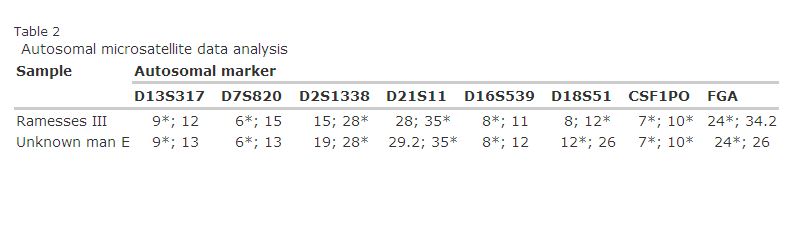
I have been looking at the autosomal DNA of Ramesses III and "Unknown Man E".  I got it from Zink's paper.


Tentatively, my guess is that the mother of Ramesses III had Greek blood.  At the locus D7S820, she has the rare  /15/, an allele which makes the best  showing in Bari, Italy, [Barion] an ancient Greek settlement of Magna Græcia.  The name of the mother of Ramesses III is Tiye Merenese, but that doesn't necessarily mean she came from the Egyptian populace. Greek ancestry could account for the light blond hair of  "Unknown Man E".   At CSF1PO, you can see that both men have 7/10.  At that marker the 7 is very rare and many populations are lacking it completely.  It seems to be an African number, but not a North African one.  Very likely it is the common allele that make the two men father and son.  The 10 is extremely common at the locus.  It doesn't mean the mother and the grandmother were related. 10 does well in most populations and is absent from only a few, such as indigenous Mexico, although in Spain it shows quite well.  10  has a large showing in Saudi Arabia, Morocco, and even among American Jewry.  I think that the mother of "Unknown Man E" can have come from a Middle Eastern population, even the Egyptian.  We'll soon see what others have to say.  You can click on the graph to enlarge.  I haven't had the chance to analyze most of the other loci yet.

Did Setnakht, the father of Ramesses III, have anything to do with Greeks?  In 2003, I wrote a paper equating the "Proteios" of the Greek writers with the pharaoh Setnakht.  This idea gained some acceptance and the paper can be read here: 
http://www.oocities.org/scribelist/setnakht.html

Proteios, king of Egypt, was said to have entertained Helen of Troy at his court.  This theme became a drama by Euripides called "Helen".  The son of  Proteios fell in love with the Spartan beauty, but she, of course, left Egypt.


Thursday, December 13, 2012

Out of Egypt?

Watch this fascinating video about a haplogroup very commonly found in Egypt, E1b1b1.  It includes Albert Einstein and some surprising others.


Friday, November 30, 2012

Nefertiti--Queen and Goddess

The religion of Akhenaten was new.  It rejected the old gods of the land but centered around the Aten, the disc of the sun.  All other manifestations of the sun were included in the theology, of course, and that is why Heliopolis, the city of the sun in the north, became the second center of the worship of the solar deity next to Akhetaten, the pharaoh Akhenaten's capital.  In order to preserve his own divine status in the scheme of things, Akhenaten represented himself as a true "son of the sun" in the guise of Shu, a light-deity who sprang from Ra and formed a kind of "holy trinity" with the sun, including the twin of Shu, Tefnut, goddess of moisture.  Nefertiti, the wife of Akhenaten, was the living incarnation of Tefnut and, truly, she was the only goddess of the new belief system, being one with Ra.  The unification of Shu and Tefnut with the sun-god preserved the monotheism of Akhenaten. 

In the tomb of Ay near the royal city, Nefertiti is called "goddess".  Ay's wife, Tey, had nursed this divine child, implying that Nefertiti had been a goddess since birth.  Remnants of the sarcophagus of Akhenaten from the royal tomb indicate that it was none other than Nefertiti who assumed the role of the protective goddess of its four corners.  No other goddess existed, but the iconography evidently remained appealing.  But the idea of Akhenaten and Nefertiti being children of the sun did not come from nothing.  It had begun in the previous generation, when Amenhotep III began to style himself “ the shining disk of the sun of Egypt”.  In other words, a sun-king. 

Here is a page that gives information about Nefertiti being attested in Year 16 of Akhenaten:
http://www.dayralbarsha.com/node/124

Tuesday, November 20, 2012

My Work With the Royal Mummies

This is the old [but "resurrected"] website on which I made my points for the identification of Amenhotep III with the mummy.  Some doubted the mummy was really that of this pharaoh, but DNA has vindicated the identity--and my work:

http://www.oocities.org/timessquare/alley/4482/am3.html

Here is a wonderful page about the Amarna masks:  http://www.flickriver.com/groups/1622542@N21/pool/interesting/
 
If  you click on the individual thumbnails, you will get to the full views.  Then look at the comments under them and you will see which ones I have tried to identify.